Phone:
+86-021-39198011
EN
WHAT ARE YOU LOOKING FOR?
Both extrusion and roll forming can produce "longer lengths with consistent cross-sections," so they are often compared in automotive and industrial manufacturing. The most fundamental difference between the two lies in the forming method: extrusion involves pushing material through a die in a single pass to form the cross-section; roll forming involves gradually bending strip material through multiple roller passes. This difference directly affects material selection, cross-section complexity, mold costs, line efficiency, and subsequent secondary processing methods.
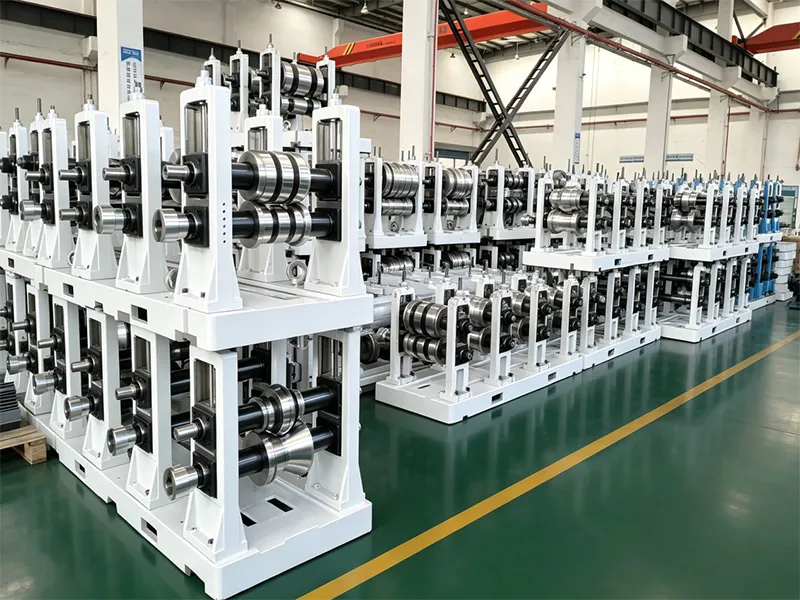
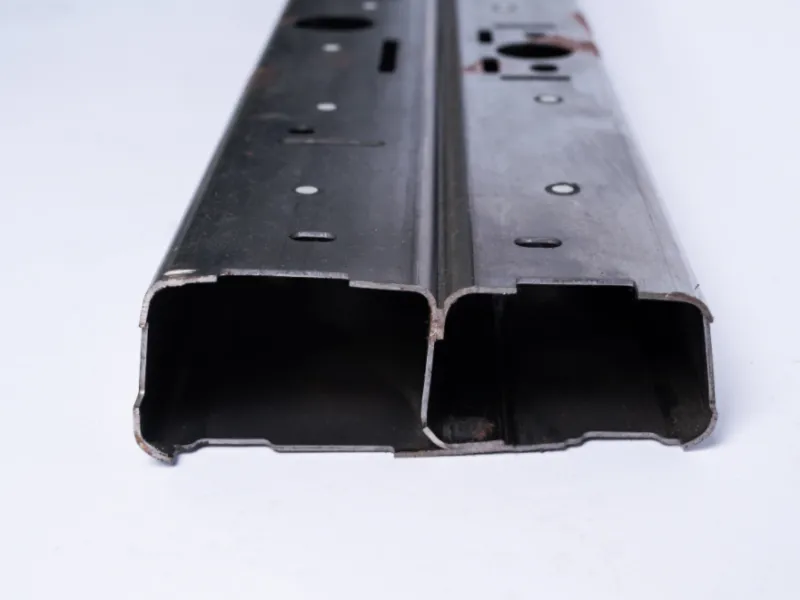
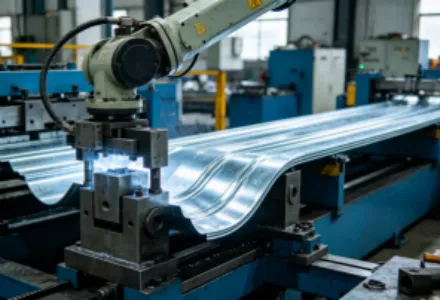
Extrusion typically involves pushing a metal billet (often heated) through a specifically shaped extrusion die under the pressure of an extruder. The extruded profile's cross-section matches the die, followed by cooling, stretching, straightening, and cutting to length. Since the cross-section is "shaped" by the die in a single pass, extrusion is very common in aluminum alloy applications, especially suitable for complex cross-sections with internal ribs, cavities, and multi-chamber structures. If the part requires assembly holes, end structures, or high-precision interfaces, secondary operations such as CNC machining, drilling, punching, and end forming are usually added after extrusion. Roll forming starts with strip or coil steel, using a series of stands (multiple roller passes) to gradually plastically deform the material: each stand only does a small amount of bending, cumulatively reaching the final cross-section. It is characterized by its continuity and stable production rhythm, making it very suitable for mass production of long-sized parts. Roll forming lines often integrate functions such as inline punching, notching, ribbing, and flying cut-to-length, bringing the part close to "assembly-ready state" when offline, reducing handling and secondary processing.
In the automotive field, the most typical material for extrusion is aluminum alloy, due to aluminum's excellent lightweight potential and corrosion resistance, making it more suitable for obtaining complex cross-sections through extrusion. Common applications include battery pack housings/frames, body reinforcement profiles, roof rails, energy-absorbing structures, and some collision management-related components. Although there are other metal extrusions, in automotive discussions, aluminum extrusions are usually the focus. Roll forming is more commonly used in the automotive industry for steel systems: plain carbon steel, galvanized/coated steel, stainless steel, and increasingly important high-strength steel/advanced high-strength steel (HSS/AHSS). This makes roll forming one of the main solutions for body structure reinforcement and safety-related parts. Typical roll-formed parts include crash beams, seat crossbeams/seat structures, sill/side reinforcement parts, longitudinal/transverse profiles, long brackets, and structural reinforcement ribs. When the material strategy leans towards using AHSS to enhance crash performance and control costs, roll forming often has strong comprehensive competitiveness.
From a cross-section design perspective, the advantage of extrusion lies in achieving higher cross-section complexity, especially structures with closed cavities, internal ribs, and complex flow/line channels. However, extrusion also has its process constraints, such as wall thickness balance, fillet transitions, extrusion speed and surface quality, post-extrusion straightness, and tolerance control. If the profile requires a large number of holes, precise assembly surfaces, or special end structures, more post-processing is often needed, which can affect cost and production rhythm. Roll forming is more suitable for cross-sections that can be "unfolded and bent" from strip material, such as C-shaped, Z-shaped, hat-shaped, channel-shaped, and multi-bend sections with flanges/returns. It excels in mass production consistency but requires careful control of springback, twisting, camber, and edge waves, especially under high-strength steel or thick gauge conditions. Its advantage lies in strong process integration capabilities: many hole positions, notches, ribs, and cut-to-length can be done inline, significantly reducing secondary operations and turnover, thus better aligning with the automotive industry's rhythm and process capability requirements.
From a cost model perspective, the choice usually depends on your production volume forecast, material route, and total cost goals. The key investment in extrusion is in extrusion molds and extrusion machine processing resources; when you need complex cross-sections, aluminum alloy lightweighting, and wish to achieve multi-function integration with "one profile," extrusion is often the more direct manufacturing path. For medium to high production volume projects, extrusion is also competitive in terms of comprehensive cost and structural efficiency. Roll forming leans more towards a "systematic production line" manufacturing method: the investment in multi-stand roller molds is relatively larger, but the return is high speed, high automation, and low unit cost, especially suitable for high-volume platform parts. If inline punching, flying shear, and other integrations can further reduce post-processing, the overall rhythm and manufacturing cost are usually more favorable. In actual projects, both processes often coexist: aluminum extrusions are used for areas requiring complex cross-sections and lightweighting; roll forming is used for high-strength steel structural parts and long profiles requiring high production rhythm supply. The most prudent approach is to evaluate manufacturability and total landed cost by combining cross-section drawings, material grades, annual production volumes, tolerance requirements, and the need for inline processes before making a final decision.